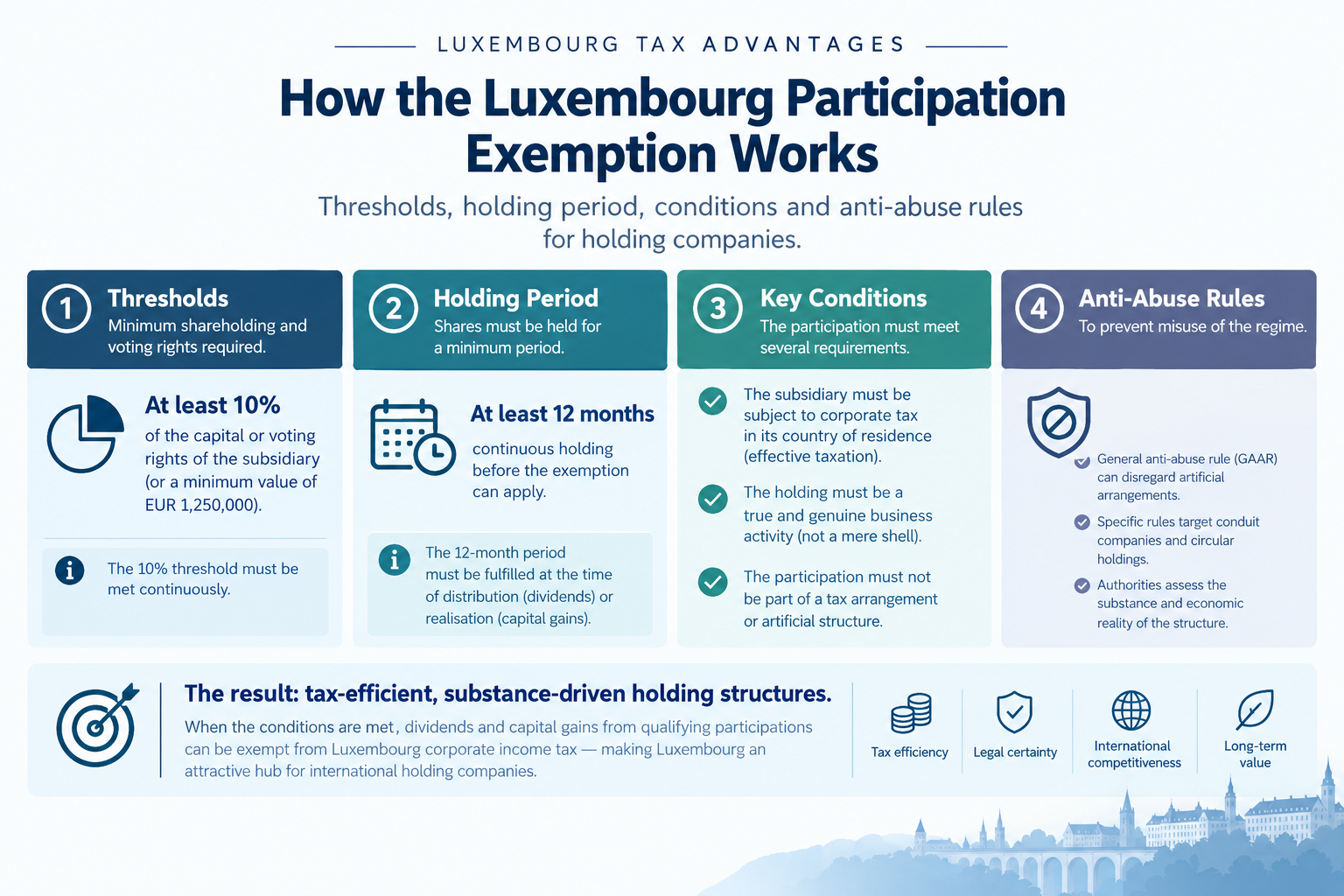
The Luxembourg Participation Exemption Explained
The participation exemption is the main reason international groups use Luxembourg holding companies. It removes a layer of tax on dividends and gains from qualifying subsidiaries. Here is how it works in practice.
What it does
A Luxembourg company that holds a qualifying participation does not pay Luxembourg corporate income tax on dividends or capital gains from that subsidiary. Profits from several countries can reach one Luxembourg company without a second layer of Luxembourg tax, and a qualifying exit can be tax-exempt.
The conditions
The exemption applies where the Luxembourg company holds or commits to hold the participation for an uninterrupted period of at least 12 months, and where one of these thresholds is met:
- Dividends and liquidation proceeds: a holding of at least 10% of the share capital, or an acquisition cost of at least €1.2 million
- Capital gains: a holding of at least 10%, or an acquisition cost of at least €6 million
The subsidiary must also be fully taxable and subject to a tax comparable to Luxembourg corporate income tax. In practice, the authorities look for an effective rate of at least half the Luxembourg rate on a similar tax base, currently around 8%.
Withholding tax on the way out
Dividends paid by a Luxembourg company are subject to 15% withholding tax by default. A foreign corporate parent can be exempt where it meets a similar test: at least 10% of the capital (or an acquisition cost of at least €1.2 million) held for 12 months, or where an EU directive or a tax treaty applies. Interest and royalties at arm’s length are generally paid without Luxembourg withholding tax.
Anti-abuse rules
The exemption is not automatic. It can be denied where the arrangement is not genuine, under Luxembourg’s general anti-abuse rule. A Luxembourg administrative court decision in November 2024 refused a withholding tax refund where the holding period and beneficial ownership could not be shown. The authorities look at whether the holding is genuinely held and managed, not just whether the percentages are met.
Opting out
Since 2025, a company can waive the exemption for a specific shareholding where the threshold is met only through the acquisition price. This can be useful for using losses or managing the effective tax rate in a group.
Practical points
Check each subsidiary separately, document the holding period, and make sure the holding company has real management and a reason to hold the shares. A shelf company can be a quick way to put the structure in place, but the tax result depends on how it is run.
Tell us about your group and we will tell you whether a Luxembourg holding company fits.