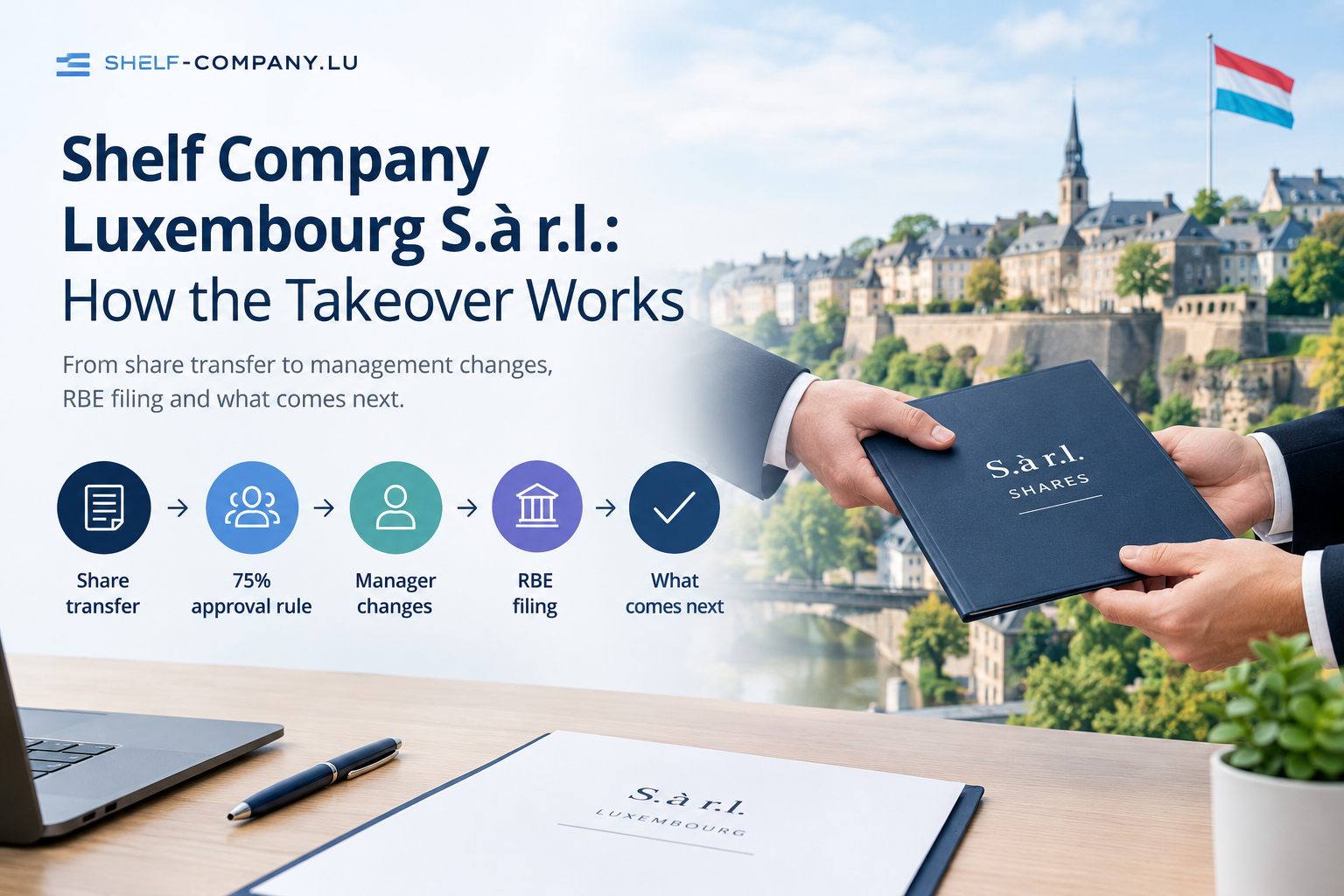
Most buyers who ask for a shelf company in Luxembourg end up with an S.à r.l. (also written SARL or Sàrl), the private limited liability company. The company already exists. What you actually buy is its shares, and then you take over its management.
This article walks through that handover step by step, and explains the S.à r.l. rules that shape it. If you are still choosing between legal forms, start with our guide to company types in Luxembourg.
What you are buying
When you acquire a shelf S.à r.l., you buy all of its shares (parts sociales). You do not buy assets or take over contracts, because a genuine shelf company has none.
The company keeps its Luxembourg Trade and Companies Register (RCS) number, its incorporation date and its articles of association. What changes is who owns it, who manages it and, if you wish, its name and address.
Why the S.à r.l. suits a shelf company
- Limited liability. Shareholders risk only what they have invested.
- Flexible ownership. It can have a single shareholder or several, up to 100.
- Tailored articles. Management powers, signing rules and share transfer rules are set in the articles, so they can be adapted to your plans.
- Paid-up capital. Shelf companies incorporated before June 2026 were incorporated with the €12,000 minimum capital paid in (see the capital note below).
The S.à r.l. rule that surprises buyers: approval of share transfers
S.à r.l. shares are not freely transferable to outsiders. By law, a transfer to a non-shareholder needs the prior approval of shareholders representing at least three quarters of the share capital. The articles can lower this to one half.
Luxembourg courts treat this approval as an essential condition of the transfer, so a transfer made without it can be challenged.
For a shelf company this is rarely an obstacle. The seller is normally the sole shareholder, and recent reforms clarified that the pre-approval step does not apply to a sole-shareholder S.à r.l. We still record the position properly in the transfer documents.
The rule matters later, though. Once you own the company and bring in a partner or investor, the same approval threshold applies to your shares. If you want a lower threshold or different rules, set them when you amend the articles after the transfer.
From signing to ownership: the steps
- Documents and identification. You provide identity and beneficial owner details. See the documents needed.
- Share transfer agreement. The shares are transferred by written agreement. This is often a private deed, although a notarial deed can be used where the parties prefer one.
- Share register. The company’s register of shareholders is updated to show you as the owner.
- New managers. The previous managers resign and you appoint yours by shareholder resolution. The change is then filed with the RCS.
- Registered address. If you want a different Luxembourg address, or a domiciliation service, it is updated at this stage.
- Name or corporate purpose, if you want to change them. This requires an amendment of the articles of association before a notary, followed by an update of the register.
- Beneficial owner register (RBE). The new ownership must be filed with the LBR within one month. Failing to file or update it can lead to fines of between €1,250 and €1,250,000.
- Bank and accounting. Your bank, accountant and tax registrations are lined up around the new ownership. See bank accounts.
Once the documents are complete, the share transfer itself usually takes only a few business days. The notary step, the RBE filing and the bank account each follow their own timeline, and the bank account is often the slowest of them.
Choosing the managers
An S.à r.l. is run by one or more managers, and its articles define their powers and how they sign. Foreign-owned companies often use a sole manager or a small board with signing rules agreed in advance.
Who you appoint affects more than the paperwork. Banks and tax authorities look at where decisions are really taken and who takes them. Read more in our article on substance for a Luxembourg company, and decide on the management structure before the transfer, not after.
A note on capital in a shelf S.à r.l.
Since 2 June 2026, founders of a new S.à r.l. can defer payment of the €12,000 minimum capital for up to 12 months. The law has no retroactive effect, so older companies were incorporated under the previous rule, with the capital paid in.
A shelf company incorporated after that date may still have capital that has not been paid. If so, you need to know how much is outstanding, when it is due, and who bears it. Share transfers involving partly paid shares need careful handling, and this should be settled in the transfer agreement. Our due diligence checklist covers how to verify this.
Four mistakes to avoid
- Choosing the name after the transfer. A name change needs a notary, so decide early if you do not want the existing name.
- Appointing managers without thinking about your bank. Choose managers with the bank’s onboarding and your tax position in mind.
- Forgetting the RBE. The one-month deadline starts when the ownership changes.
- Treating the shelf company as finished. The company still has annual accounts and tax returns to file. See what it costs to run a Luxembourg company.
Frequently asked questions
Can I buy a shelf S.à r.l. if I do not live in Luxembourg?
Yes. Non-residents commonly do. You provide identification and beneficial owner details, and you need a Luxembourg registered address, which a domiciliation service can provide.
Do I need a notary to buy a shelf S.à r.l.?
The share transfer itself can often be documented by a private deed. A notary is needed for amendments to the articles, such as a new name or corporate purpose.
Does the company keep its age and RCS number?
Yes. Only the owner, managers and any details you choose to change are updated. The registration number and incorporation date stay the same.
How long does the transfer take?
Once all documents are complete, the share transfer usually takes a few business days. Notary steps, the RBE filing and the bank account follow separately.
Is a shelf S.à r.l. better than forming a new one?
It depends on your timeline and how much control you want over the name and articles. Our comparison of a shelf company and a new company sets out the trade-offs.
Next step
Tell us what you plan to do with your Luxembourg S.à r.l., and we will send you a summary of the requirements and a timetable. See how to buy a Luxembourg shelf company and our services for your shelf company, or contact us directly.
This article is for general information only and is not legal, tax or financial advice. Rules change, so confirm the details with a qualified professional before making decisions.